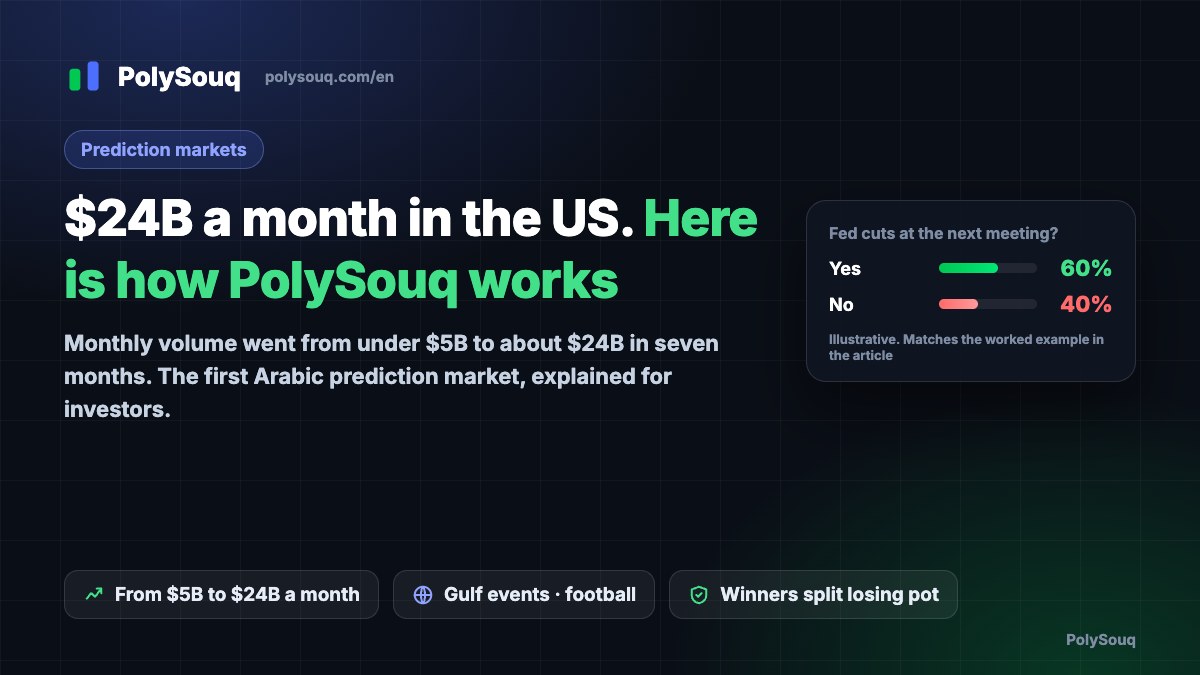
Prediction markets just became a $24 billion-a-month business
For most of the last decade, prediction markets were a niche that political scientists liked and regulators tolerated. That changed quickly. According to the Pew Research Center (May 27, 2026), the combined monthly trading volume on Kalshi and Polymarket rose from under $5 billion in September 2025 to about $24 billion in April 2026. For scale, Pew notes that legal US sports wagering averaged about $14 billion a month across 2025, so event contracts are now moving more money each month than the industry they are most often compared with.
| Measure | Figure | Source |
|---|---|---|
| Kalshi + Polymarket monthly volume, September 2025 | under $5B | Pew Research Center, May 2026 |
| Kalshi + Polymarket monthly volume, April 2026 | about $24B | Pew Research Center, May 2026 |
| Polymarket US vs Polymarket International, April 2026 | $1.3B vs $9B | Pew Research Center, May 2026 |
| Kalshi topic mix since July 2024 | sports 80% · crypto 7% · politics 4% | Pew Research Center, May 2026 |
| Polymarket topic mix since July 2024 | sports 39% · politics 32% · crypto 20% | Pew Research Center, May 2026 |
| Kalshi share of the US CFTC-regulated market | about 89% | CoinDesk, April 9, 2026 |
Two things in that table matter for this article. First, the market is concentrated: CoinDesk (April 9, 2026) put Kalshi at about 89% of the US regulated market, and Pew’s split shows Polymarket doing $9 billion internationally against $1.3 billion in the US. Second, the topic mix is dominated by sports and US politics. An investor in Riyadh or Dubai who wants a market on the next OPEC decision, a Tadawul IPO, or the Saudi Pro League title has had nowhere to go.
Why the Arab world had no platform of its own
Kalshi and Polymarket are English-only products built around US and European events. Their interfaces do not run right-to-left, their calendars do not think in Riyadh time, and their catalogues rarely touch the questions that move Gulf portfolios. The region has more than 400 million Arabic speakers and two of the most actively traded equity markets in emerging markets, Tadawul and the UAE exchanges, yet until 2026 there was no Arabic-language, locally focused event market.
PolySouq (بولي سوق, “poly market” in Arabic) launched to fill that gap as the firstarab prediction site built for the region. The interface is Arabic first, with an English mirror at polysouq.com/en, dates are Gregorian, times are Saudi time, and the catalogue is written for the region rather than translated from someone else’s. Real-money trading has been live since August 2026.
What PolySouq lists that a stock investor will recognise
The catalogue is organised around multi-answer events, meaning questions with three or more possible outcomes, plus a set of short-window price markets. The categories an investor is most likely to care about:
| Category | Typical questions | Where |
|---|---|---|
| Saudi market | TASI level ranges, Tadawul IPO pricing and first-day performance, Aramco announcements | Saudi Arabia |
| UAE market | DFM and ADX events, Dubai real-estate transaction records, new listings | UAE |
| Economics | OPEC+ output decisions, US and Gulf rate moves, CPI prints, oil price ranges | Economics |
| Politics and geopolitics | Elections, summits, ceasefire and treaty milestones, regional appointments | Politics |
| Crypto | Bitcoin and Ethereum 5-minute Up/Down windows, plus 4-hour, daily, weekly and monthly ranges | Crypto 5M |
| Forex and commodities | Gold (XAUUSD), oil (USOIL), EURUSD, USDJPY and silver Up/Down markets | Forex |
| Football | 1X2 markets per fixture across the Champions League, Premier League, La Liga, Serie A, Bundesliga, Ligue 1 and the Saudi Pro League | Premier League |
For a US-stocks reader the interesting part is the overlap with things you already follow. A rate decision, a CPI print or an OPEC meeting moves the S&P 500 and Tadawul on the same afternoon. A prediction market puts a live probability on the outcome, which is useful information even if you never take a position. The same applies closer to home: theprediction markets UAE section prices DFM and ADX listings and Dubai property records weeks before the official figures land.
Parimutuel versus an order book versus owning the stock
Kalshi and Polymarket run continuous order books: you buy a contract from another trader at a price between 0 and 100 cents, and you can sell it back before the event settles. PolySouq uses a parimutuel pool. All the money on YES goes into one pot, all the money on NO into another, and when the event resolves the correct side splits the incorrect side’s pot. The displayed probability is simply the share of the total pool sitting on each answer.
| Feature | PolySouq (parimutuel) | Order-book prediction market | Owning a stock |
|---|---|---|---|
| What you hold | A stake in the YES or NO pool of one event | A contract that pays $1 if correct | A share of a company |
| Price you get | Set by the pool split at resolution | Set by the best available order | Set by the market at the time of the trade |
| Can you get out early? | No — buy-only, held to resolution | Yes, if there is a buyer | Yes, during market hours |
| Leverage | None | None on the contract itself | Optional, via margin |
| Maximum loss | The amount staked | The amount paid for the contract | The amount invested (more with margin) |
| Fees | 10% of the losing pot only; no deposit fee, no spread | Trading fees and/or spread | Commission, spread, FX, custody |
| Income while holding | None | None | Dividends, where paid |
| Time horizon | Fixed: the event date | Fixed: the event date | Open-ended |
The consequence of buy-only is worth sitting with. On PolySouq a position is a decision, not a trade you manage. There is no stop-loss, no averaging down and no taking profit at 80 cents. You decide how much you are willing to lose, you buy, and you wait for the event.
A worked example, in dollars
Take a market on whether the Federal Reserve cuts at its next meeting. By the close of trading the YES pool holds $600 and the NO pool holds $400, so the screen shows YES at 60% and NO at 40%. You put $100 on YES.
- The Fed cuts. The NO pool of $400 is the losing pot. PolySouq takes its 10% commission from that pot only: $40. The remaining $360 is shared among YES backers in proportion to their stakes. Your $100 is one-sixth of the $600 YES pool, so you receive one-sixth of $360, which is $60, plus your original $100 back. Total returned: $160.
- The Fed holds. YES is the losing side. Your $100 goes into the losing pot and you receive nothing. Your loss is exactly $100 — never more, because there is no leverage and no further margin call.
- Nobody took the other side. If, say, everyone had backed YES and YES won, there is no losing pot to distribute and no commission to take. Every stake is refunded in full. The same applies if you were the only participant, and to any market that is voided or cancelled.
Notice that the commission never touches a winner’s own stake. Winning traders get 100% of their money back plus their share of 90% of the losing pot. Losing traders lose their stake. The platform’s revenue comes entirely from that 10% slice, which is why there is no deposit fee, no monthly fee and no spread.
Opening an account and funding it with USDC
PolySouq runs on one funding rail: USDC on the Polygon network, for both deposits and withdrawals, with a $5 minimum in each direction. There are no cards or bank transfers. If you already hold USDC on an exchange that supports Polygon withdrawals, the whole process takes a few minutes.
- Open polysouq.com/en/signup and create the account with email and password, Google, or Apple sign-in.
- Verify the email. Trading and commenting are locked until this is done.
- Pick your interests. A personalised feed is built from them, so an investor who selects Saudi market, economics and forex sees those events first.
- Go to Portfolio, choose Add funds, and copy your personal Polygon USDC address.
- Send USDC from any wallet or exchange that supports the Polygon network. Balances then show in dollars.
- Open an event and buy YES or NO at the displayed probability.
Friends, the accuracy leaderboard and the ideas feed
PolySouq frames itself as a place to test your knowledge rather than as a trading venue, and the social features follow from that. Every account gets a personal invite link in Settings; friends who join can be challenged on the same events at polysouq.com/en/play. A weekly accuracy leaderboard ranks users by how often their predictions were right, not by how much they made, which changes the incentive: one well-judged $5 position counts as much as a $500 one. If you challenge a friend and nobody takes the other side, the parimutuel refund rule means you both get your money back.
The Ideas feed is a community layer with posts, replies, mentions, bookmarks and profiles, where users share the reasoning behind a position. Every event also has its own comment thread. Posting requires a verified email, which keeps the feed thinner and more useful than an open forum.
Transparency, culture and who runs it
Settlement is automated by consensus of public sources; anything ambiguous goes to a human review queue rather than being resolved by a script. Every resolved market shows its outcome and the source it was resolved against, and the leaderboard is public. That audit trail is the closest thing a prediction market has to an exchange’s trade tape.
The platform states that it respects Arab culture and values and does not list events that contradict them. In practice that means the catalogue leans toward markets, economics, politics, sport and technology, and the language throughout is “I predict” rather than anything else. The operating company is registered in Cyprus, and the terms of service are governed by Cypriot law.
“Polymarket proved that people want to put a number on what they believe. What it never did was ask what someone in Jeddah or Abu Dhabi believes about their own market. We built PolySouq for that person, in their language, with the events that actually decide their week,” says Mike Brend, PolySouq’s Chief Marketing Officer.
Is PolySouq a betting site?
The comparison comes up, so it is worth answering directly. A sportsbook or bookmaker sets odds against you and profits when you lose; the house is your counterparty. In a gambling product the operator’s margin is built into every price. On PolySouq the counterparty is other users: the platform never takes a side, never sets a price, and earns the same 10% of the losing pot whichever answer wins. The published probability is the crowd’s aggregated view, which is why economists use prediction-market prices as forecasts and why the product is framed as testing your knowledge. It is still a market in which you can lose your full stake, and it should be sized like one.